Rapid Application Development Explained
Rapid application development (RAD) lets you ship working software in weeks, not months. Traditional development cycles burn time on exhaustive upfront planning — RAD flips that model entirely, putting prototypes in front of real users fast and iterating based on what actually works.
If you are building a SaaS product, marketplace, or custom web application and need to validate ideas without committing to a 12-month waterfall project, understanding what is rapid application development is the most practical starting point.
This article covers everything: how RAD works, where it beats traditional methods, which frameworks power it, and the tools teams use today.

What Is Rapid Application Development (RAD)?
Rapid application development is a software development methodology that prioritizes fast prototyping, continuous user feedback, and iterative delivery over rigid upfront planning.
The concept was formalized by James Martin in his 1991 book Rapid Application Development. Martin argued that traditional waterfall approaches wasted enormous time gathering requirements that changed before a single line of code shipped. His answer: build fast, show users something real, and adjust continuously.
Key Insight: What is rapid application development, at its core? It is the idea that a working prototype in the hands of users generates more useful feedback in one week than six months of documented requirements ever could.
The RAD life cycle compresses the traditional development timeline by running design, development, and testing phases in parallel rather than sequentially. Teams produce functional components early, gather feedback, and refine — repeating that loop until the product is ready.
Rapid application development is widely used in SaaS development, internal tooling, and marketplace platforms where speed to market directly affects competitive position.
Key Characteristics of RAD
What is rapid application development without understanding what makes it distinct? These are the defining traits:
- Rapid prototyping: Teams build working prototypes quickly — not mockups, but functional components users can interact with. This drives real feedback instead of theoretical input.
- Iterative development: The product evolves through short cycles. Each iteration adds, refines, or removes features based on what users actually need.
- Active user involvement: Users and stakeholders participate throughout the build, not just at the start and end. Customer satisfaction is built into the process, not bolted on at delivery.
- Small, focused teams: RAD works best with 2–6 person teams. Larger teams introduce coordination overhead that kills the speed advantage.
- Minimal upfront planning: Requirements are defined loosely at the start and refined as the product takes shape. This is a feature, not a bug.
- Reusable components: RAD teams leverage existing libraries, frameworks, and modules. Building from scratch is avoided wherever possible.
RAD vs Traditional Software Development
The clearest way to understand what is rapid application development is to compare it directly against the waterfall model most enterprise teams default to.
RAD vs Waterfall: A Direct Comparison
| Dimension | RAD | Traditional Waterfall |
|---|---|---|
| Planning phase | Light, evolves with product | Exhaustive upfront documentation |
| User involvement | Continuous throughout | Front-loaded (requirements) and end-loaded (UAT) |
| Delivery timeline | Weeks to first working prototype | Months before anything ships |
| Change tolerance | High — changes are expected | Low — changes are expensive mid-cycle |
| Team size | Small, cross-functional | Often large, siloed by discipline |
| Risk profile | Lower — problems surface early | Higher — problems surface late |
| Best for | Evolving requirements, fast validation | Fixed requirements, regulated environments |
The waterfall model works when requirements are stable and unlikely to change — think compliance systems or infrastructure software with strict regulatory specifications. RAD wins when the product definition is still evolving and speed to validation matters more than exhaustive documentation.
For SaaS founders and marketplace builders, RAD is almost always the right default. You do not know exactly what users want until they use something real.
RAD Methodologies and Frameworks
What is rapid application development in practice? It is not a single method — it is a family of related approaches that share the same core philosophy.
The James Martin RAD Model
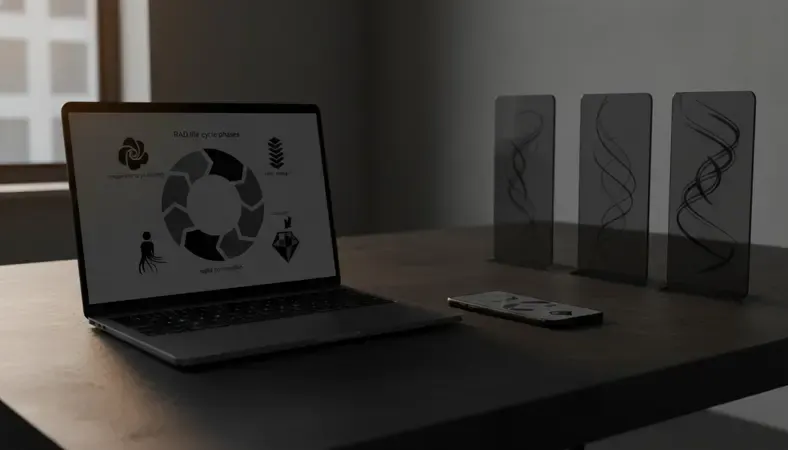
The original RAD life cycle defined by James Martin has four phases:
- Requirements planning: Stakeholders define high-level goals and constraints. This is deliberately brief — days, not weeks.
- User design: Teams build prototypes and work with users in rapid prototyping workshops. Feedback is captured and immediately fed back into design.
- Rapid construction: Developers build functional components using reusable code and automated tools. Testing happens in parallel with development.
- Cutover: The final product is deployed, users are trained, and the system goes live.
Agile
Agile software development is the most widely adopted evolution of RAD principles. It formalizes iterative development into time-boxed sprints (typically two weeks), with defined ceremonies: sprint planning, daily standups, retrospectives, and reviews. Agile is the default methodology for most SaaS teams today.
Scrum
Scrum is the most popular Agile framework. It adds specific roles (Product Owner, Scrum Master, Development Team) and structures work into sprints with a prioritized backlog. For teams building with Ruby on Rails or SaaS Development Services, Scrum provides just enough structure without killing velocity.
Extreme Programming (XP)
XP pushes RAD principles further with practices like test-driven development (TDD), pair programming, and continuous integration. It is particularly relevant for teams where code quality and Rails Testing with RSpec are priorities alongside speed.
Low-Code/No-Code RAD
Modern low-code platforms represent the most literal interpretation of what is rapid application development. They allow non-developers to build functional applications through visual interfaces, dramatically compressing the build phase.
Advantages and Disadvantages of RAD
No methodology is universally correct. Here is an honest assessment of where RAD delivers and where it falls short.
Advantages
- Speed: Teams ship working software in weeks. A typical RAD project delivers a functional prototype in 2–4 weeks versus 3–6 months for waterfall.
- Customer satisfaction: Continuous user involvement means the final product reflects what users actually need. Surprises at launch are rare.
- Lower risk: Problems surface early when they are cheap to fix, not at the end of a six-month cycle when they are expensive.
- Flexibility: Changing requirements are handled naturally. The process expects and accommodates change.
- Better product-market fit: Iterating on real user feedback produces products that solve actual problems, not assumed ones.
Disadvantages
- Not suited for large teams: RAD loses its speed advantage when teams grow beyond 6–8 people. Coordination costs rise faster than output.
- Requires active user participation: If stakeholders are unavailable or disengaged, the feedback loops that power RAD break down.
- Difficult for fixed-scope projects: Government contracts or enterprise deals with locked specifications do not fit the RAD model well.
- Technical debt risk: Moving fast without discipline creates brittle code. Teams need Rails Performance Optimization practices built into their process, not treated as optional.
- Documentation is often thin: RAD prioritizes working software over documentation. This creates problems when team members change or when regulatory compliance requires audit trails.
When to Use Rapid Application Development
Knowing what is rapid application development means knowing when to apply it. RAD is the right choice when:
- Requirements are unclear or likely to change: If you are building a new product and do not yet know exactly what users want, RAD is built for this situation.
- Time to market is critical: Competitive markets reward the team that ships first and iterates, not the team that plans longest and ships once.
- User involvement is available: You have access to real users or stakeholders who can provide feedback throughout the build.
- The project is small to medium scale: RAD works best for projects where a small team can maintain shared context across the entire codebase.
- You are building a SaaS product or marketplace: These product types have inherently evolving requirements. What users need in month three is different from what they said they needed in month one.
RAD is not the right choice when:
* The project has fixed, non-negotiable requirements (regulatory systems, safety-critical software)
* The team is large and distributed with high coordination overhead
* The client requires exhaustive documentation and formal sign-offs at each stage
YOUTUBE_EMBED: https://www.youtube.com/watch?v=JHcxbGwHtsY
RAD Tools and Platforms
The tools teams use to execute what is rapid application development have matured significantly. Here are the categories and leading options.
Prototyping and Design
- Figma: The standard for rapid UI prototyping. Teams build interactive mockups in hours, share them with users, and gather feedback before writing a line of code.
- Balsamiq: Wireframing tool optimized for speed. Low-fidelity wireframes communicate structure without getting stakeholders distracted by visual polish.
Development Frameworks
- Ruby on Rails: The original rapid application development framework for web applications. Rails' convention-over-configuration philosophy means teams build full-featured applications in a fraction of the time other frameworks require. Techvinta 2 specializes in Rails-based SaaS development for exactly this reason.
- React.js + Ruby on Rails: Combining a Rails API backend with a React frontend delivers RAD speed with modern UI flexibility. This stack is well-suited for marketplace platforms and SaaS products that need real-time interfaces.
- Flutter + Ruby on Rails: For teams building mobile and web simultaneously, Flutter on the frontend with a Rails API backend compresses the multi-platform build timeline significantly.
Project Management
- Jira: Sprint planning, backlog management, and velocity tracking. Standard for Agile/Scrum teams.
- Linear: A faster, cleaner alternative to Jira popular with SaaS startups. Optimized for small teams moving quickly.
- Notion: Combines documentation, sprint tracking, and team wikis in one tool. Good for early-stage teams that need flexibility.
Low-Code Platforms
- Bubble: Visual web application builder. Allows non-developers to build functional web apps without code.
- Retool: Internal tool builder. Excellent for rapid development of admin dashboards and operational tools.
Testing and CI/CD
- RSpec: The standard testing framework for Rails applications. Writing tests in parallel with development — rather than after — is a core RAD discipline.
- GitHub Actions: Automated testing and deployment pipelines. Continuous integration keeps fast-moving codebases stable.
Common Questions About Rapid Application Development
Is rapid application development the same as Agile?
RAD and Agile share the same core philosophy — iterate fast, involve users, adapt to change. Agile is best understood as a formalized, widely adopted evolution of the original RAD principles James Martin defined. RAD is the concept; Agile and Scrum are the structured frameworks most teams use to implement it today.
How long does a RAD project take?
A typical RAD project delivers a working prototype in 2–4 weeks. A full initial release takes 2–4 months depending on complexity. The key distinction: something functional ships early, and the product evolves from there rather than waiting for a "complete" version.
What is the RAD life cycle?
The RAD life cycle has four phases: requirements planning (brief, high-level), user design (rapid prototyping with user feedback), rapid construction (parallel build and test), and cutover (deployment and training). The cycle repeats as needed, with each iteration adding or refining features.
Does RAD work for enterprise software?
RAD works for enterprise software when requirements are flexible and stakeholders are available for ongoing feedback. It struggles in enterprise contexts with fixed specifications, large distributed teams, or heavy compliance requirements. Many enterprises use a hybrid approach: RAD principles for early-stage product discovery, more structured methods for final delivery and documentation.
What skills does a RAD team need?
Effective RAD teams need full-stack development skills, comfort with iterative work, and strong communication with non-technical stakeholders. Developers who work well in short cycles, adapt quickly to changing requirements, and write testable code from the start are the right profile. Experience with a full stack development framework like Ruby on Rails accelerates RAD significantly.
Key Takeaways
Rapid application development solves the core problem of traditional software delivery: building the wrong thing slowly. By shipping prototypes early, involving users continuously, and iterating based on real feedback, RAD consistently produces better products faster.
Launch your SaaS product or marketplace with Techvinta 2 — a Ruby on Rails and full stack development agency specializing in rapid, scalable web application delivery from first prototype to production. Ready to get started? Visit Techvinta 2 to learn more.

