SaaS application development is how modern software gets built, deployed, and scaled — without shipping a single CD or managing a customer's server. If you are a startup founder, product manager, or technical lead evaluating whether to build a SaaS product, this guide covers everything you need to make smart decisions: architecture, frameworks, tools, costs, and how to choose the right development partner.

What Is SaaS Application Development?
SaaS application development is the process of designing, building, and deploying software that users access via a web browser or API — hosted in the cloud, billed on a subscription model, and maintained entirely by the vendor.
Unlike traditional software, a SaaS product is never "installed." Users log in. Updates happen automatically. Infrastructure scales with demand. This model shifts the burden of maintenance from the customer to the development team — which is exactly why it demands a different approach to architecture and engineering.
The global SaaS market has grown from under $50 billion in 2015 to over $230 billion today, and it continues expanding as businesses replace on-premise tools with cloud-native alternatives.
SaaS application development covers the full lifecycle: product discovery, technical architecture, frontend and backend engineering, infrastructure setup, security, and ongoing iteration. Getting any one of these wrong creates compounding problems — slow performance, security vulnerabilities, or an architecture that cannot scale past your first 100 customers.
Key Insight: The biggest mistake in SaaS application development is treating it like building a regular web app. Multi-tenancy, subscription billing, and zero-downtime deployments require deliberate architectural decisions from day one.
SaaS Development Frameworks and Technologies
Choosing the right technology stack for saas application development is one of the most consequential early decisions. The wrong choice creates technical debt that slows every future feature.
Backend Frameworks
The backend handles your business logic, data, and API layer. Three frameworks dominate serious SaaS application development:
Ruby on Rails: The fastest framework for getting a SaaS product to market. Rails conventions eliminate boilerplate decisions. Stripe, GitHub, and Shopify were all built on Rails. For teams using Techvinta 2, Ruby on Rails is the primary recommendation for SaaS backends that need rapid iteration without sacrificing structure. See our guide on Ruby on Rails 8 for what the latest version brings to production SaaS apps.
Node.js: Excellent for real-time features — chat, notifications, live dashboards. JavaScript across the full stack reduces context switching for smaller teams.
Django (Python): Strong choice when data processing, machine learning, or scientific computing is core to your product.
Frontend Approaches
React.js: The dominant choice for complex, interactive SaaS dashboards. Component-based architecture scales well as your product grows. Pairing React.js + Ruby on Rails gives you a clean API boundary and independent deployment cycles.
Hotwire & Turbo in Rails: For teams that want rich interactivity without a full JavaScript framework, Hotwire delivers page-speed performance with minimal frontend complexity. This is increasingly popular for B2B SaaS tools where raw performance matters more than animation.
Vue.js: Lighter than React, easier onboarding for smaller teams. Good fit for SaaS products with moderate UI complexity.
Infrastructure
Most SaaS application development teams deploy on AWS, Google Cloud, or Heroku (for early-stage). Containerization with Docker and orchestration with Kubernetes becomes relevant once you pass product-market fit and need horizontal scaling.
SaaS Architecture and Best Practices
Architecture decisions in saas application development are not reversible without significant cost. Here is what separates well-architected SaaS products from ones that break under growth.
Multi-Tenancy Models
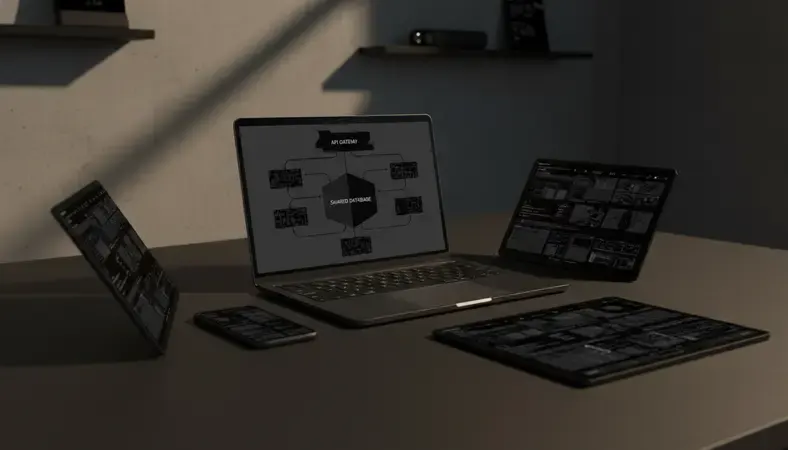
Multi-tenancy means one application instance serves multiple customers. There are three common approaches:
Comparing Multi-Tenancy Approaches
| Model | Data Isolation | Complexity | Best For |
|---|---|---|---|
| Shared database, shared schema | Low — row-level isolation | Low | Early-stage SaaS, fast launch |
| Shared database, separate schemas | Medium — schema per tenant | Medium | B2B SaaS with compliance needs |
| Separate databases per tenant | High — full isolation | High | Enterprise SaaS, regulated industries |
Most SaaS products start with a shared database and shared schema, then migrate toward separate schemas as enterprise customers demand stronger data isolation. Plan for this migration from the start — retrofitting it later is painful.
API-First Design
Build your SaaS product as an API-first system. Your frontend, mobile apps, and third-party integrations all consume the same API. This creates a clean separation of concerns and makes future integrations — Zapier, Slack, Salesforce — straightforward to add.
REST APIs work well for most SaaS products. GraphQL becomes valuable when your frontend teams need flexible data fetching across complex data models.
Authentication and Authorization
Every SaaS product needs:
- Multi-factor authentication (MFA): Non-negotiable for B2B products
- Role-based access control (RBAC): Admins, members, read-only users — define these early
- SSO support: Enterprise customers will require SAML or OAuth-based single sign-on
- Session management: Secure token handling, refresh logic, and revocation
Subscription Billing Infrastructure
Stripe is the standard for SaaS billing. Integrate it at the data model level — not as an afterthought. Your subscription status, plan limits, and feature flags should be first-class entities in your database schema.
SaaS Development Tools and Platforms
The right tools reduce friction across every phase of saas application development. These are what production SaaS teams actually use.
Development and Collaboration
- GitHub or GitLab: Version control and code review. Pull request workflows enforce quality before code reaches production.
- Linear or Jira: Issue tracking and sprint management. Linear is faster for early-stage teams; Jira scales for larger engineering organizations.
- Figma: Design handoff between product and engineering. Reduces ambiguity in UI specifications.
CI/CD and Deployment
Continuous integration and continuous deployment are not optional in modern saas application development. Every commit should trigger automated tests. Passing builds should deploy automatically to staging.
- GitHub Actions: Free for most teams, tightly integrated with GitHub repositories
- CircleCI or Buildkite: More configuration options for complex pipelines
- Heroku: Fastest path to production for early-stage SaaS; managed infrastructure removes DevOps overhead
- Render or Fly.io: Modern alternatives to Heroku with better pricing at scale
Monitoring and Observability
- Datadog or New Relic: Application performance monitoring. Set alerts on response time, error rates, and database query performance.
- Sentry: Error tracking. Know about exceptions before your customers report them.
- PagerDuty: On-call alerting for production incidents.
For teams focused on Rails performance, see our guide on Rails Performance Optimization — it covers database indexing, query optimization, and caching strategies specific to SaaS workloads.
Testing Infrastructure
Shipping SaaS without a test suite is a liability. Rails Testing with RSpec is the standard approach for Ruby on Rails SaaS products — it gives you unit tests, integration tests, and request specs that catch regressions before they reach production.
SaaS Development Services and Solutions
Not every team builds in-house. SaaS application development services range from full-product development agencies to specialized consulting for specific phases.
What SaaS Development Services Cover
A full-service saas application development partner handles:
- Product discovery: Translating business requirements into technical specifications, user stories, and architecture decisions
- MVP development: Building the minimum viable product with production-quality code — not throwaway prototypes
- Infrastructure setup: Cloud provisioning, CI/CD pipelines, monitoring, and security hardening
YOUTUBEEMBED: https://www.youtube.com/watch?v=aVyI1oV5vU
- Ongoing development: Feature iteration, performance optimization, and technical debt management
- Technical advisory: Architecture reviews, technology selection, and team scaling guidance
Build In-House vs. Hire a Development Partner
| Factor | In-House Team | Development Partner |
|---|---|---|
| Speed to first build | Slow — recruiting takes months | Fast — team starts within weeks |
| Cost structure | High fixed cost (salaries, benefits) | Variable — scales with project scope |
| Domain expertise | Builds over time | Immediate, specialized |
| Long-term control | Full ownership of roadmap | Depends on contract structure |
| Best for | Post-PMF scaling | Pre-PMF and early-stage SaaS |
Techvinta 2 specializes in SaaS application development for startups and companies building marketplace platforms. The team works primarily in Ruby on Rails, React.js, and Flutter — covering both web and mobile SaaS products. For teams that need SaaS Development Services That Deliver, the focus is always on production-ready code, not proof-of-concept work.
Cost and Timeline for SaaS Development
Cost and timeline in saas application development depend on scope, team structure, and the complexity of your architecture. Here is an honest breakdown.
What Drives Cost
- Feature scope: A simple SaaS tool with one core workflow costs a fraction of a multi-tenant platform with complex RBAC, billing, and integrations
- Team composition: Senior engineers cost more per hour but write less code — they solve problems at the architecture level before they become expensive bugs
- Technology choices: Managed infrastructure (Heroku, Render) reduces DevOps cost early; custom Kubernetes clusters add cost but give more control at scale
- Integration complexity: Connecting to Stripe, Twilio, Salesforce, or custom enterprise systems adds significant scope
Typical Timeline Phases
- Discovery and architecture (2–4 weeks): Requirements, technical spec, database schema, API design
- MVP development (8–16 weeks): Core features, authentication, billing integration, basic admin
- Beta and testing (4–6 weeks): Load testing, security review, user acceptance testing
- Launch and iteration (ongoing): Feature additions, performance optimization, scaling
A focused MVP for a B2B SaaS product — one core workflow, Stripe billing, multi-user accounts — typically takes 12–20 weeks with a small team of 2–3 engineers.
Why It Matters: Rushing the discovery phase to save time almost always adds weeks to the development phase. Unclear requirements create rework. Invest 2–4 weeks in architecture before writing a line of application code.
Choosing a SaaS Development Partner
The right saas application development partner accelerates your timeline and prevents expensive architectural mistakes. The wrong one ships code that breaks at scale.

What to Evaluate
- SaaS-specific experience: Have they built multi-tenant products with subscription billing before? Ask for specific examples — not just "we build web apps."
- Technology alignment: Do they work in the stack you have chosen? A Rails shop should not be building your Django product, and vice versa.
- Communication structure: How do they handle sprint planning, code reviews, and stakeholder updates? Async-first teams work better for distributed clients.
- Code quality standards: Ask about their testing practices. A team without a CI/CD pipeline and test coverage is a team that ships bugs to production.
- Post-launch support: SaaS products need ongoing maintenance. Clarify what happens after launch — do they hand off code and disappear, or do they support iteration?
Questions to Ask Before Signing
- What is your approach to multi-tenancy and data isolation?
- How do you handle database migrations in a zero-downtime deployment?
- What monitoring and alerting do you set up by default?
- Can you show us a Rails application you have built with subscription billing?
- How do you manage scope changes during development?
The software development lifecycle for SaaS products requires partners who understand that launch is not the finish line — it is the starting point for ongoing iteration.
Common Questions About SaaS Application Development
What is the difference between SaaS and a regular web application?
A regular web application serves one organization or user base. A SaaS application is designed from the start to serve multiple independent customers (tenants) on shared infrastructure. This requires deliberate decisions about data isolation, billing, role management, and scalability that a standard web app does not need.
How long does SaaS application development take?
A focused MVP takes 12–20 weeks. A full-featured platform with enterprise capabilities — SSO, advanced RBAC, custom integrations — takes 6–12 months. Timeline depends heavily on scope clarity at the start. Teams that invest in discovery and architecture before coding consistently ship faster.
What programming language is best for SaaS development?
Ruby on Rails is the fastest path to a production-quality SaaS MVP. It is the choice of Shopify, GitHub, and Basecamp for good reason. Node.js is better for real-time features. Python/Django is better when data processing is core to the product. The right answer depends on your product's primary value proposition.
Do I need a mobile app for my SaaS product?
Most B2B SaaS products launch web-first. A responsive web application covers 80% of use cases. Mobile apps add significant development cost and maintenance overhead. Build mobile when your users genuinely need offline access or device-native features — not because it sounds good in a pitch deck.
How do I handle data security in a SaaS application?
Start with encryption at rest and in transit (TLS 1.3 minimum). Implement proper authentication with MFA. Use role-based access control so users only see data they are authorized to access. For data security in multi-tenant SaaS, tenant isolation at the database level is the strongest protection. Run regular dependency audits and penetration tests before enterprise sales conversations.
What is the best way to structure SaaS pricing?
Per-seat pricing works for collaboration tools. Usage-based pricing works for API products and infrastructure. Flat-rate tiers work for tools with a clear feature differentiation between customer segments. Most successful SaaS products start with simple flat-rate tiers and add usage-based components as they understand their customers' value metrics better.
Conclusion
SaaS application development rewards teams that make deliberate decisions early — on architecture, technology stack, and the right development partner. The fundamentals do not change: multi-tenancy, API-first design, automated testing, and subscription billing infrastructure are non-negotiable.
Launch your SaaS product with Techvinta 2 — a full-stack development team specializing in Ruby on Rails SaaS platforms, marketplace applications, and scalable web products built to grow with your business. Ready to get started? Visit Techvinta 2 to learn more.


